
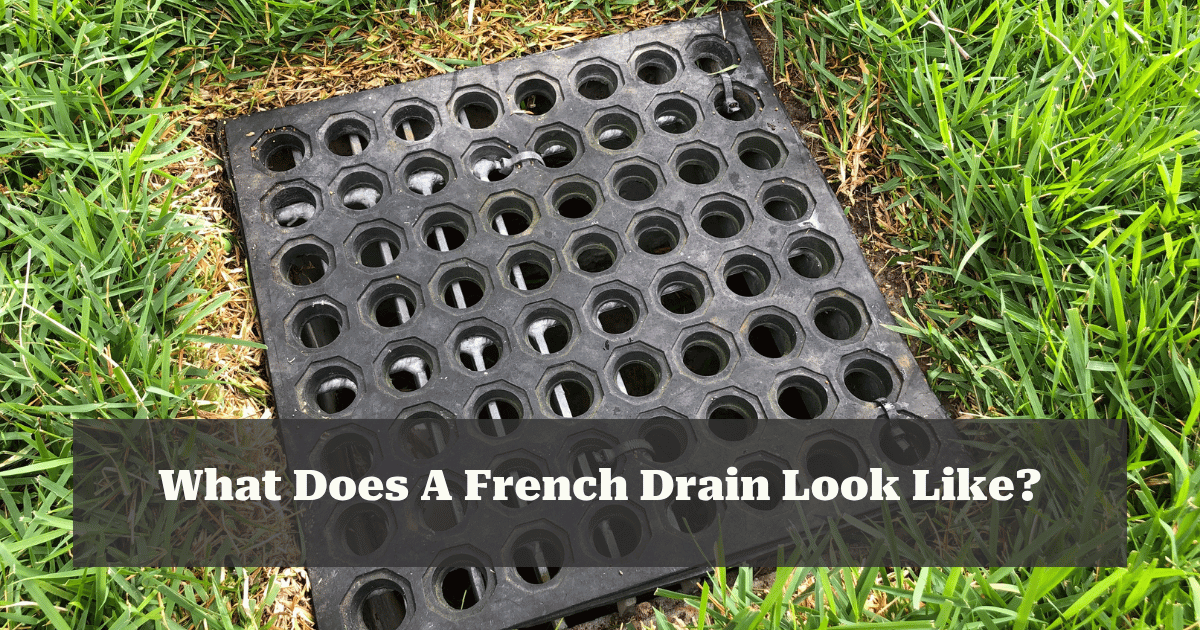
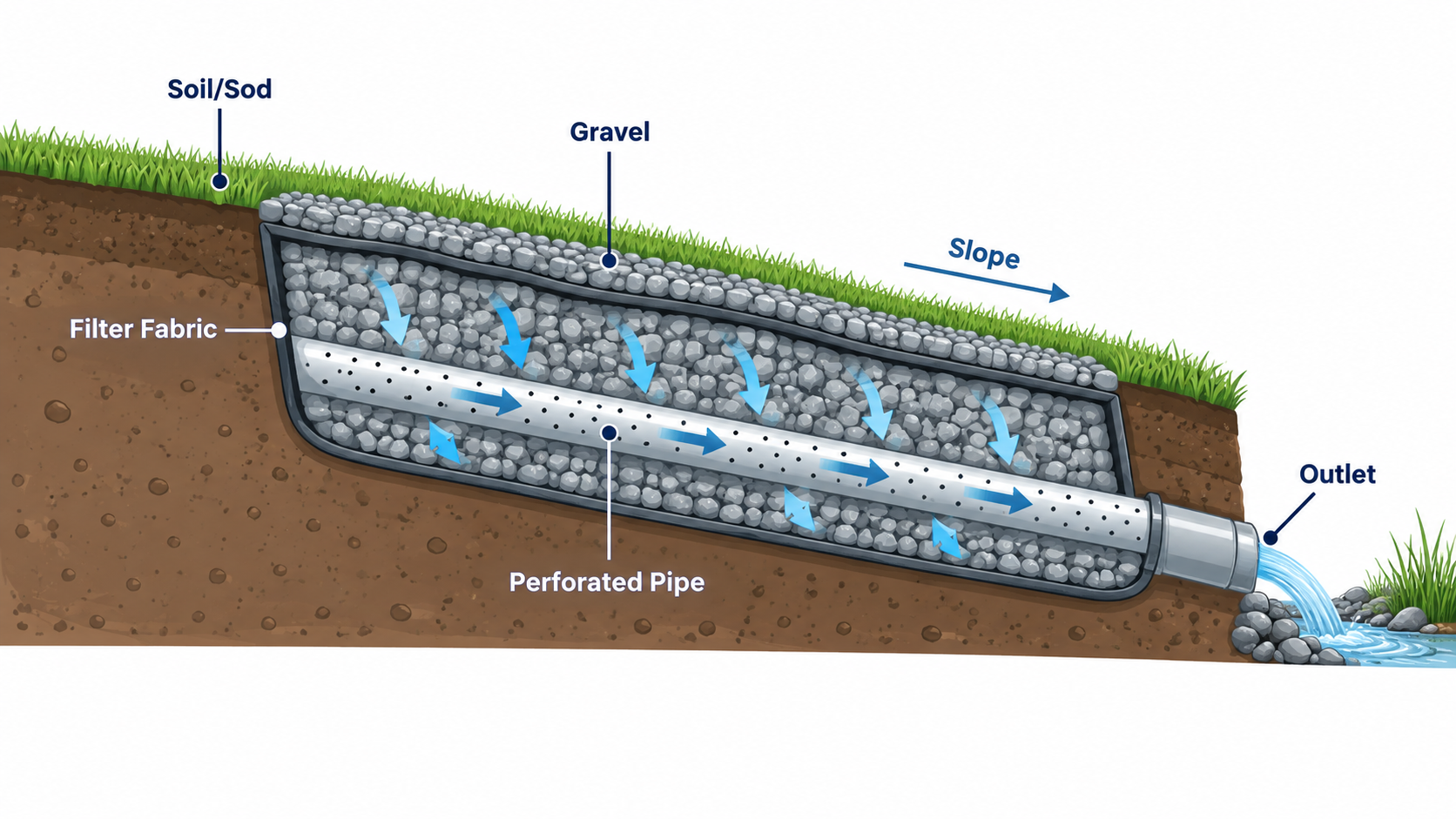
If you are looking at a wet yard, a strip of gravel beside the house, or an unexplained pipe near the bottom of a slope, you may be wondering: what does a french drain look like? From above, it can look like a narrow gravel bed, a tidy rock border, or almost nothing at all. Below ground, the working parts usually include a sloped trench, filter fabric, clean gravel, and perforated pipe that collects and redirects water.
The Quick Picture Before You Start Digging
- Many French drains look like a long strip of gravel or decorative rock.
- A finished system may be covered with soil, sod, or landscaping.
- Below the surface, water moves through gravel toward a perforated pipe.
- The trench needs a consistent downhill path toward a suitable outlet.
- A French drain is not the same as a grated trench drain.
- A visible outlet may be the only obvious sign of a fully buried system.
So, What Does A French Drain Look Like From Above?
The most recognizable version is a narrow band of stone running across a wet part of the yard, along the uphill side of a building, or beside a foundation. The stone may be plain washed gravel or decorative rock that blends into the landscaping.
Some French drains are completely buried. Once sod or soil is restored, you may only notice a subtle line in the lawn, an outlet farther downhill, or simply better drainage after rain.
| What You See | What May Be Underneath |
|---|---|
| Long gravel strip | Fabric, drain rock, and perforated pipe |
| Faint straight depression in grass | A buried trench that has settled slightly |
| Short pipe opening downhill | The discharge end of the system |
| Rock-lined channel | A French drain, curtain drain, or surface drainage feature |
| Ground-level grate | Usually a catch basin or trench drain |
A French drain should follow the water problem. In some yards, that means crossing a slope to intercept groundwater or runoff before it reaches the house.
What Is Inside A French Drain?
Cut through a typical French drain and you would see several layers rather than an empty pipe buried in soil.
Washington State University Extension describes French drainage as a trench that can include geotextile fabric, perforated plastic pipe, and gravel. The fabric helps separate surrounding soil from the drainage material so fine particles are less likely to fill the spaces water needs to move through.
A typical installation may include:
- An excavated trench shaped to maintain drainage fall
- Geotextile or filter fabric
- Clean, free-draining gravel
- Perforated drainage pipe
- Additional gravel around and above the pipe
- Fabric folded over the drainage stone
- Gravel, soil, sod, or landscaping as the finished surface
University of Minnesota Extension also describes French drains as gravel-filled trenches that can use perforated pipe to collect and carry water.
Practical Tip: The gravel is functional, not simply decorative. The spaces between clean stones allow water to move toward the drainage pipe instead of sitting in compacted soil.
The Detail That Makes A French Drain Work: Slope
A French drain may look simple, but a trench without proper fall can hold water instead of carrying it away.
Washington State University Extension recommends a trench slope of approximately 0.5% to 1%. A 1% slope represents about 1 foot of vertical drop across 100 horizontal feet.
That sounds minor, but it becomes important on longer drainage runs. If you start digging without checking elevation, the trench may eventually become too shallow, too deep, or unable to reach a usable outlet.
This is why the discharge point should be considered before excavation begins.
Local rules also matter. King County provides guidance on protecting sewer and stormwater systems, and drainage should never simply be redirected toward a neighboring property or connected to a sewer system without confirming that the connection is permitted.
French Drain Or Trench Drain?
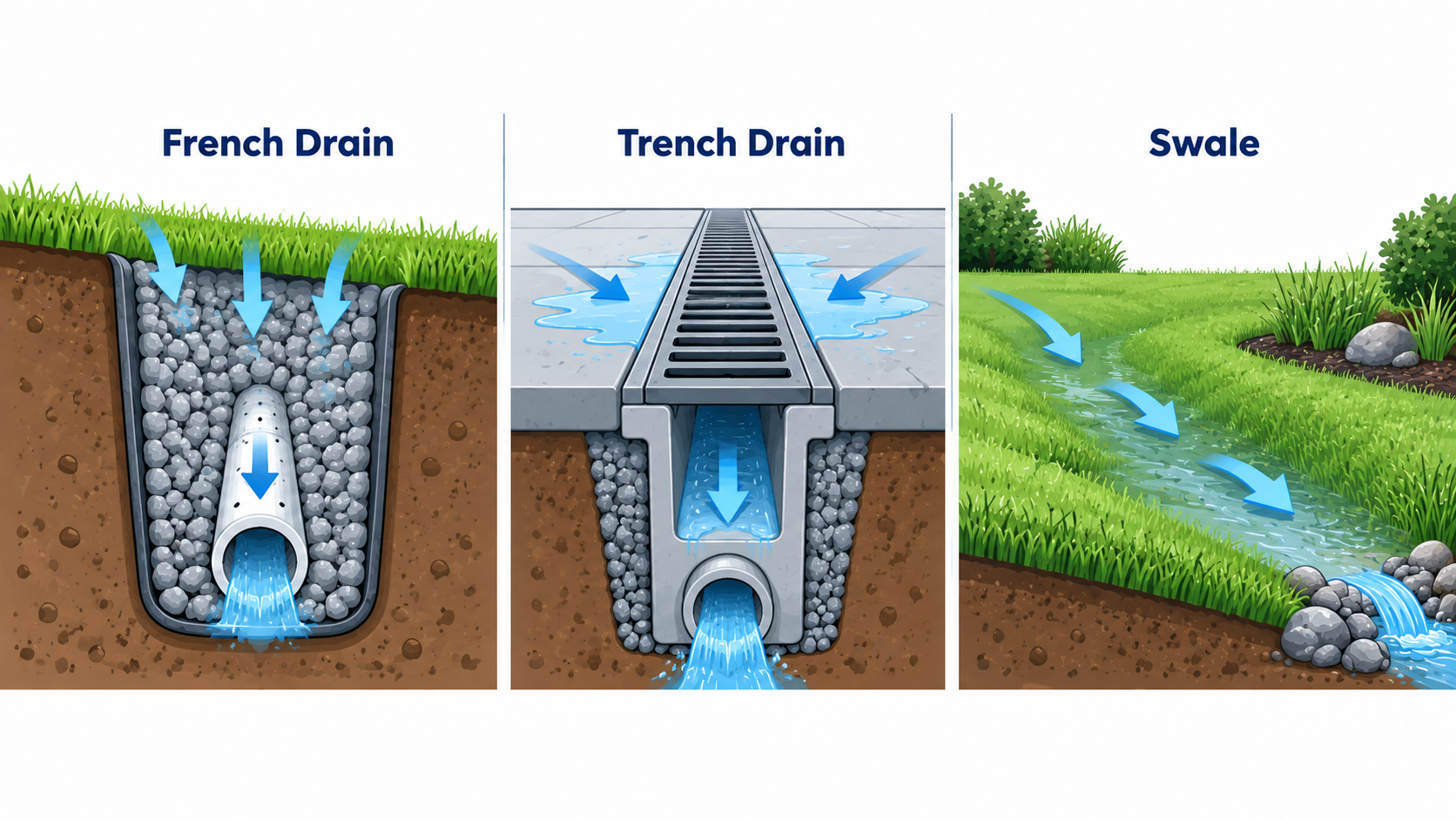
A French drain is primarily a subsurface drainage system. Water moves through the surrounding gravel and enters a perforated pipe underground.
A trench drain captures water at the surface. It normally has a visible grate and is commonly installed across driveways, patios, garage entrances, pool areas, or other hard surfaces.
A swale is different again. It is usually a broad, shallow depression formed in the landscape to guide or temporarily hold runoff.
If you are still wondering what does a french drain look like on your property, follow the suspected system from beginning to end. Look for where water gathers, where the gravel or buried trench runs, and where the collected water eventually exits.
What Should A Properly Installed French Drain Not Look Like?
A French drain should not simply be a random trench filled with rocks.
Poor installation can leave you with a trench that collects water but cannot move it effectively. It should also not repeatedly rise and fall along its route because low sections can become holding areas for sediment and water.
Watch for signs such as:
- Fine soil filling the spaces between the gravel
- Standing water that remains long after rainfall
- A crushed or flattened drain pipe
- An outlet buried by mulch, soil, or vegetation
- Water being discharged back toward the foundation
- Runoff being directed onto neighboring property
- Repeated soggy areas along the drainage route
- Water collecting at one end without reaching the outlet
Safety Warning: Before excavating, contact 811. The Washington Utilities and Transportation Commission advises requesting an underground utility locate before digging.
When The Water Problem May Be Bigger Than A French Drain
Not every wet spot requires a French drain.
Water around a home can come from roof runoff, poor grading, high groundwater, a sump pump problem, an underground water-line leak, a damaged sewer line, or another plumbing issue.
A French drain cannot repair a leaking water pipe or broken sewer line.
Pay closer attention if the wet area:
- Appears even during dry weather
- Develops suddenly after years without a problem
- Has an unusual or sewage-like odor
- Appears alongside slow indoor drains
- Is accompanied by unusually lush patches of grass
- Develops near buried plumbing or sewer lines
These signs can point to a problem that needs diagnosis before any drainage trench is installed.
When Local Plumbing Experience Matters
Trusted Plumbing & Heating works with homeowners and businesses throughout the greater Puget Sound region, including Renton, Seattle, Bellevue, Kent, Auburn, Federal Way, and surrounding communities.
The company handles drain, sewer, main-line, sump-pump, underground piping, and other plumbing issues. That experience can be important when standing water looks like a landscaping problem but may actually be connected to buried plumbing, a sewer line, or a sump system.
Founder Jim Cunningham has more than 40 years of hands-on plumbing experience. When unexplained water keeps returning, identifying where it is coming from before choosing a solution can prevent unnecessary excavation and help determine whether the issue belongs above ground or below it.
Why Choose Trusted Plumbing & Heating
- Family-owned and operated
- More than 40 years of plumbing experience under founder Jim Cunningham
- Washington plumbing contractor license TRUSTPH781NC
- Licensed, insured, and bonded technicians
- Member of the Washington Plumbing-Heating-Cooling Contractors Association
- Service throughout King and Pierce Counties
Get The Water Problem Identified Before It Spreads
If you are dealing with unexplained pooling, recurring drainage problems, sump-pump concerns, or signs that an underground plumbing line may be involved, get in touch with Trusted Plumbing & Heating for professional help.
The team serves Renton, Seattle, Bellevue, Kent, Auburn, Federal Way, Tacoma, and surrounding Puget Sound communities.
Frequently Asked Questions
What Does A French Drain Look Like When It Is Finished?
It may look like a narrow gravel strip or be almost invisible beneath soil and sod.
A visible outlet, cleanout, decorative stone border, or slight linear depression in the ground may be the only clue that a drainage system is underneath.
Can A French Drain Be Completely Covered With Grass?
Yes, some French drains can be covered with soil and sod after the drainage materials are installed.
The appropriate surface finish depends on how the system was designed and how readily water needs to enter the trench.
Why Is There No Visible Pipe In My French Drain?
That is normal because the perforated pipe is typically installed below ground inside the drainage gravel.
The pipe collects water after it moves through the surrounding stone.
Does A French Drain Always Need A Pipe?
Not every gravel drainage trench contains pipe, but many modern residential French drain systems use perforated pipe.
The pipe provides a defined path that helps collected water move toward the discharge point.
Can I Connect A French Drain Directly To A Sewer?
Do not assume that you can.
Stormwater and sewer connections are controlled by local requirements, so the permitted discharge location should be confirmed before making any connection.
How Can I Tell If My French Drain Is Clogged?
Persistent ponding, slow drainage, water backing up around the trench, or little flow from the outlet during wet weather can indicate a blockage.
Other possible causes include poor slope, soil contamination in the gravel, damaged pipe, or an obstructed discharge point.