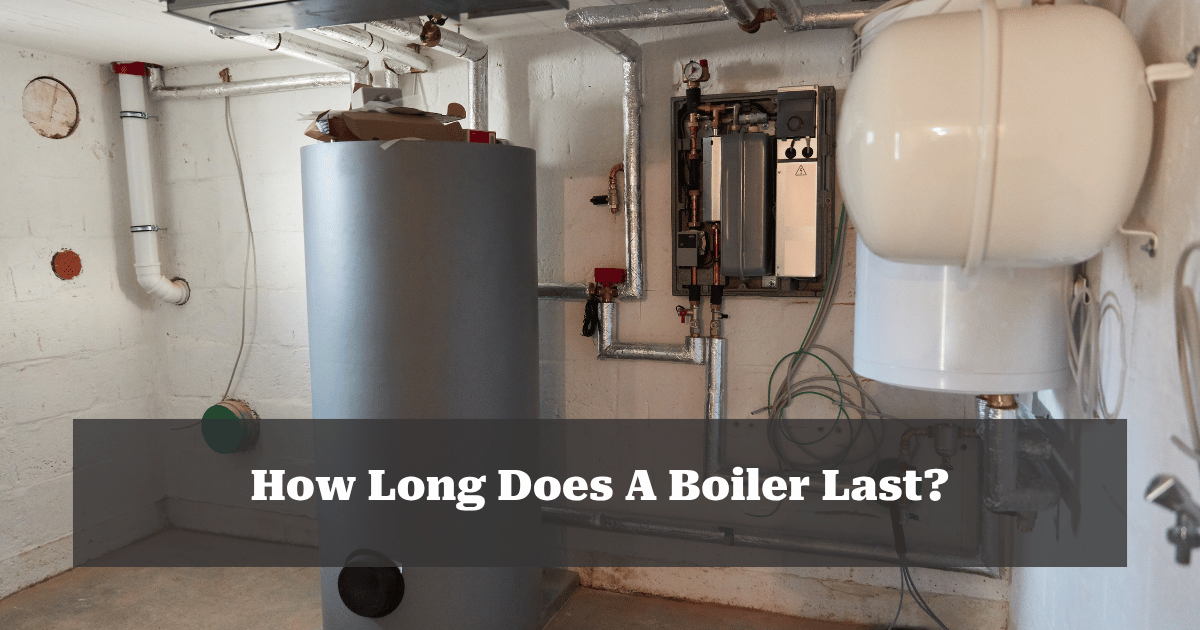
If you are asking how long does a boiler last, the useful answer is not one fixed number. Many modern residential systems are planned around a 10-15 years service window, but the actual boiler lifespan can be shorter or much longer depending on equipment type, installation quality, water conditions, workload, and maintenance. Some older cast-iron equipment stays in service for decades, while a neglected high-efficiency system can develop expensive problems much earlier.
What Homeowners Should Know First
- Age matters, but condition matters more. A 16-year-old system running cleanly can be a better candidate for continued service than a 10-year-old system with repeated failures.
- Annual servicing helps catch combustion, venting, pressure, control, and corrosion problems before they become bigger issues.
- Frequent pressure loss, leaks, unusual noises, uneven heating, or rising fuel use deserve attention.
- A correctly sized installation usually has an easier operational life than equipment that constantly short-cycles.
- Older equipment does not automatically mean unsafe equipment, but fuel-burning systems should receive professional inspection.
- Replacement decisions should consider reliability, efficiency, service history, and available parts, not age alone.
What Is The Average Boiler Lifespan?
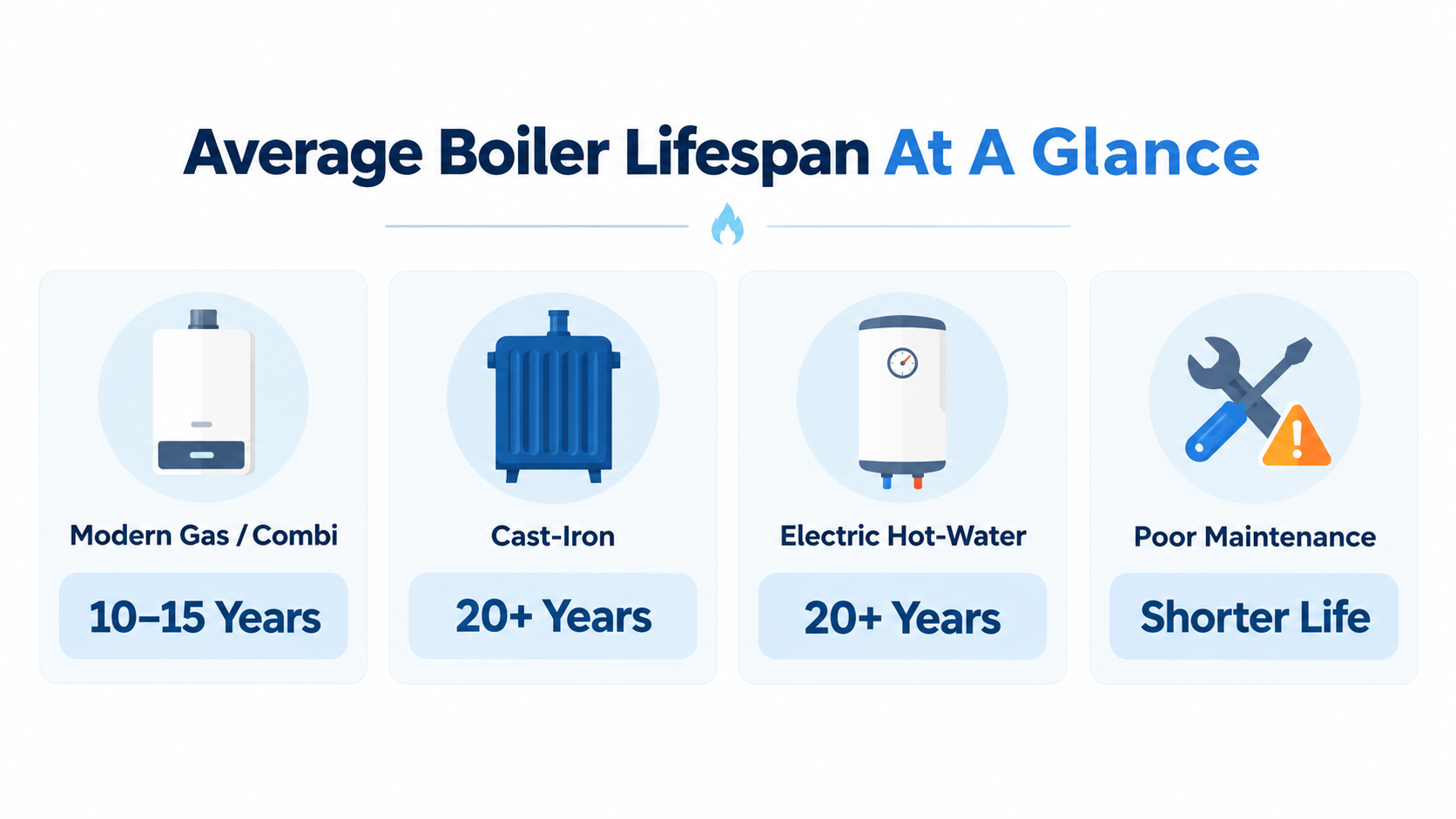
For homeowners wondering how long does a boiler last, 10-15 years is a useful planning range for many modern residential units, especially compact or combi boiler systems. It should not be treated as an expiration date.
Real service-life data shows why a single number can be misleading. The ASHRAE HVAC Service Life Database reports service-life information across different types of heating equipment. Its data includes median ages around 24 years for cast-iron boilers and 22 years for electric hot-water boilers represented in the database, while several steel hot-water categories fall roughly within the 12-to-21-year range.
Equipment construction and operating conditions clearly make a difference.
| Boiler Type Or Situation | Practical Lifespan Perspective |
|---|---|
| Modern gas or combi boiler | Often planned around 10-15 years |
| Cast-iron system | Can remain in service well beyond 20 years |
| Electric hot-water system | Can also reach 20 years or more |
| Poorly maintained equipment | May develop costly failures much earlier |
What Actually Shortens Boiler Life?
A boiler usually does not fail simply because it reaches a certain birthday. Wear develops through repeated heat cycles, water chemistry problems, scale, corrosion, poor combustion, leaking components, or controls working harder than they should.
Short-cycling is a good example. If heating equipment is oversized for the home or the controls are poorly configured, it may fire, stop, and start again far more often than necessary. That repeated cycling puts additional wear on burners, ignition components, pumps, valves, and controls.
Water quality also matters. Scale can coat heat-transfer surfaces and force the equipment to work harder to deliver the same comfort. Corrosion can weaken metal components and eventually create leaks.
In a hydronic heating system, repeated pressure changes or frequent make-up water can also indicate a problem that deserves investigation.
A System That Constantly Needs Its Pressure Topped Up Is Telling You Something. Find The Cause Instead Of Only Resetting The Gauge.
Can Annual Service Make A Boiler Last Longer?
Yes. Annual service cannot stop normal aging, but annual servicing can reduce avoidable wear and identify developing problems while they are still manageable.
The U.S. Consumer Product Safety Commission recommends a yearly professional inspection of fuel-burning home heating systems, including boilers, fireplaces, furnaces, water heaters, chimneys, flues, and vents.
This is particularly important with gas boiler systems because improper combustion or damaged venting can create carbon monoxide risks.
A thorough boiler service may include checking:
- Combustion performance
- Venting and exhaust
- System pressure
- Safety controls
- Pumps and valves
- Electrical connections
- Visible leaks or corrosion
- Heat exchanger condition
The exact maintenance schedule should always follow the equipment manufacturer’s requirements.
Annual Maintenance Is Not Only About Avoiding Breakdowns. It Can Reveal Small Changes In Combustion, Pressure, Or Component Condition Before They Turn Into Expensive Failures.
When Does An Older System Make More Sense To Replace?
When homeowners ask how long does a boiler last, they are often really asking whether spending more money on the existing equipment still makes sense.
Keeping the current unit can be reasonable when the problem is isolated, replacement parts remain available, the equipment has been properly maintained, and the rest of the heating system is in good condition.
Replacement becomes easier to justify when problems keep returning, important components are failing, parts are becoming difficult to source, or the system can no longer heat the home consistently.
A major upgrade can also make sense when an older gas boiler uses considerably more fuel than modern equipment.
The ENERGY STAR boiler guidance states that certified gas boilers have AFUE ratings of at least 90%. The U.S. Department of Energy’s high-efficiency boiler guidance notes that some high-performance systems can exceed 94% AFUE.
Actual savings still depend on the equipment being replaced, the home’s heat loss, fuel prices, controls, and correct installation.
Interesting Fact: A Newer High-Efficiency System Will Not Perform At Its Best If It Is Oversized. Correct Sizing Matters Almost As Much As The Efficiency Rating.
Signs Your Heating System Needs Professional Attention
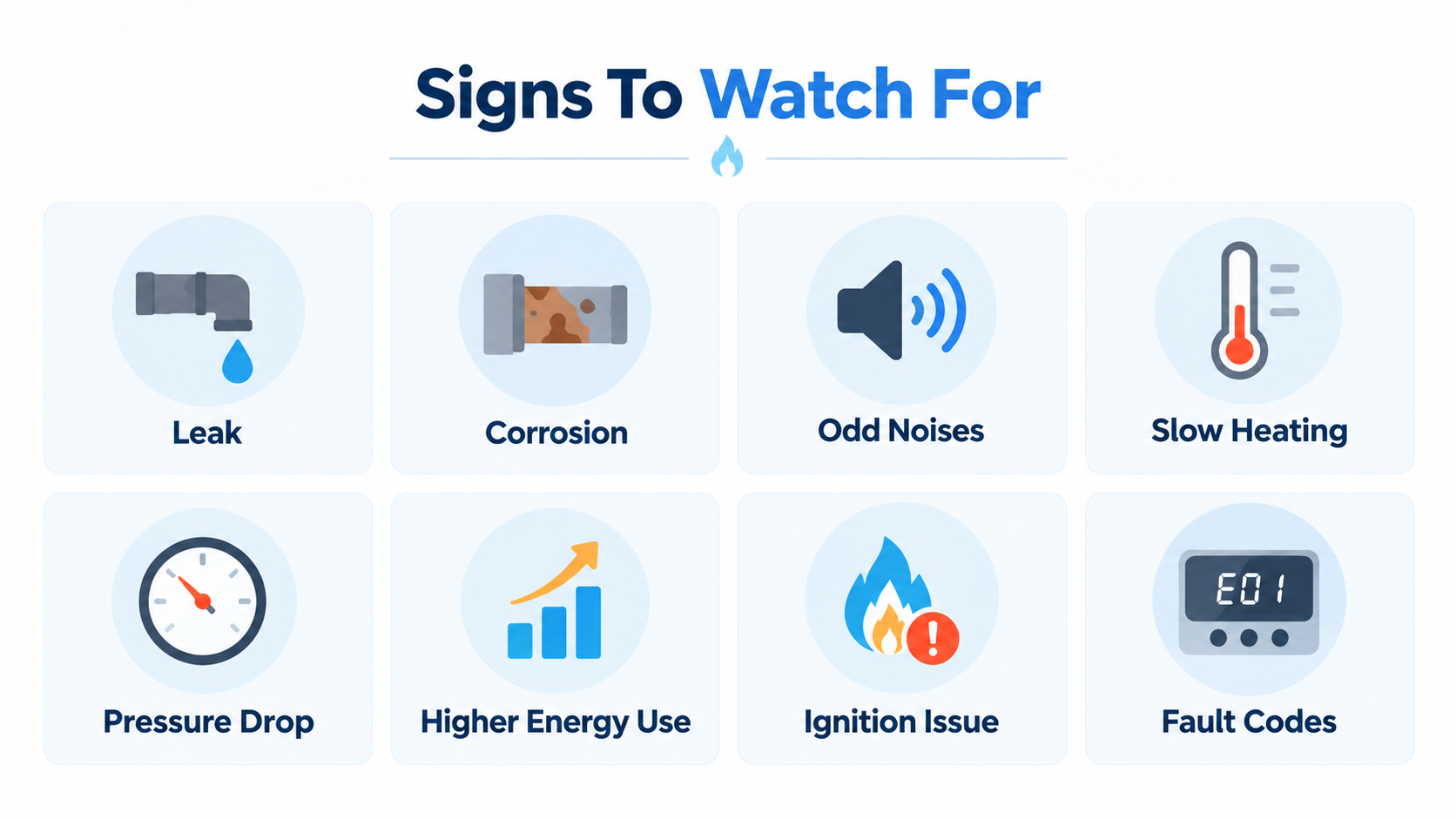
Do not wait for a complete loss of heating if you notice:
- Water around the unit or visible corrosion
- Banging, kettling, whistling, or grinding sounds
- Rooms taking noticeably longer to warm
- Repeated pressure drops
- Unexpected increases in energy use
- Burner or ignition problems
- Frequent resets or recurring fault codes
- Heating that becomes inconsistent from room to room
Some problems may only require repair or maintenance, while others can indicate that the system is approaching the end of its practical operational life.
If a carbon monoxide alarm sounds, leave the home and follow emergency guidance. Do not attempt to diagnose a fuel-burning appliance yourself. The U.S. Consumer Product Safety Commission warns that damaged or blocked venting and improperly operating heating equipment can create dangerous carbon monoxide conditions.
Local Help With Aging Boilers
Trusted Plumbing & Heating handles boiler inspections, repair, upgrades, and installation as part of its plumbing and heating services. The company focuses on identifying the cause of a problem, explaining the recommended work clearly, and completing projects with long-term heating performance in mind.
Owner and founder Jim Cunningham brings more than 40 years of hands-on plumbing experience. Trusted Plumbing & Heating is family-owned and operated, with licensed, insured, and bonded professionals serving local homeowners and businesses.
When heating equipment is getting older, professional inspection can help determine whether the problem calls for maintenance, one specific repair, or a larger replacement project.
Why Choose Trusted Plumbing & Heating?
- More than 40 years of industry experience
- Family-owned and operated local company
- Washington construction license TRUSTPH840KO
- Plumbing contractor license TRUSTPH781NC
- Boiler inspection, repair, upgrade, and installation services
- Residential and commercial plumbing and heating experience
Get Help Before A Small Problem Becomes A Cold-House Problem
If your boiler is aging, noisy, leaking, losing pressure, or no longer heating your home consistently, having it checked before the next cold stretch can help prevent a more disruptive failure.
Trusted Plumbing & Heating serves Renton, West Seattle, Kent, Tacoma, and surrounding communities throughout King and Pierce Counties.
Get in touch to schedule service and find out whether your heating system needs maintenance, a targeted repair, or replacement.
Frequently Asked Questions
Can A Boiler Last 30 Years?
Yes, some boilers can last 30 years or longer, particularly durable older systems that have been properly maintained. Condition, corrosion, controls, efficiency, and replacement-parts availability still matter more than age alone.
Does A Combi Boiler Have A Shorter Lifespan?
A combi boiler can face a demanding workload because one appliance handles both space heating and domestic hot water. Its lifespan depends heavily on sizing, water quality, usage, installation, and maintenance.
Should I Replace A Boiler That Still Works?
Not automatically. If the equipment remains safe, reliable, serviceable, and reasonably efficient, keeping it can make sense until operating costs or recurring repair problems change the equation.
Why Does My Boiler Keep Losing Pressure?
Repeated pressure loss can indicate a leak, expansion-vessel problem, pressure-relief issue, or another system fault. A technician should identify the actual cause instead of relying on frequent refilling.
Is A New Boiler Always More Efficient?
A modern boiler is often more efficient than significantly older equipment, but real-world savings depend on its efficiency rating, installation quality, sizing, controls, and the performance of the system being replaced.
How Often Should A Boiler Be Serviced?
An annual service is a sensible schedule for most residential boilers, especially fuel-burning equipment. Regular professional inspection can identify safety, combustion, pressure, and component problems before they develop into larger repairs.